

How Personality Traits Impact Entrepreneurial Success

Do you think certain personality traits give founders an edge? In this blog we’ll dive deeper into this topic and we’re kicking off with a Forbes article that explores how personality traits influence entrepreneurial success. After that, we’ll support this insight with a large-scale study published at PNAS that analyzed over 10,000 tech founders to uncover how their personalities impact key start-up milestones. The central question is what separates those who take the leap into entrepreneurship from those who stick with traditional careers. Research suggests founders share distinct personality traits that set them apart. A study in Nature (referenced in the Forbes article) identified key traits that are more common among founders than employees.
Key personality traits of founders
The first identified personality trait of founders is resilience and optimism, because founders tend to have low anxiety and depression it allows them to bounce back from setbacks and maintain energy in challenging times. This goes hand in hand with the second personality trait: confidence and assertiveness. It’s proven that many successful founders show a high level of confidence – sometimes this devolves into extreme boldness. A developed feeling of self-assuredness helps them navigate the uncertainty of start-up life.
Another important trait is openness and creativity, essential for fresh ideas and innovative thinking are high levels of curiosity and creativity. This is the key to securing funding and finding business opportunities! The last key personality trait associated with founders has to do with social skills: it’s cooperation and trust that great founders know how to work well with others. Their high level of cooperation helps them build strong, supportive teams, which is crucial to business growth.
PNAS
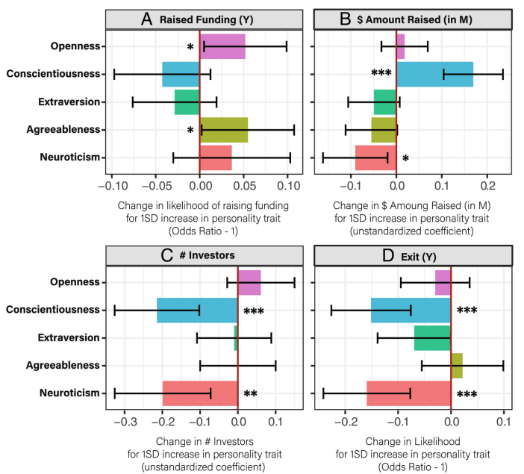
PNAS-research backs up previous findings, it mentions the major influence of the founder’s personality in the start-up success with some traits that ‘predict’ success across all stages, while others shift in importance as a business grows. Key traits they identify are openness in regard to creativity and curiosity. Where founders who were ranked higher in an open attitude were 5% more likely to secure early funding. Investors clearly value fresh ideas and innovative thinking as a result of the openness of the founder. The second trait they mentioned was agreeableness connected to cooperation and trust. This study stated that more agreeable founders attracted investors more easily, likely due to strong networking and persuasion skills.
A third trait equally important to have as a founder is conscientiousness connected to organization and discipline. This is however a double-edged sword! Founders high in conscientiousness raised about $170K more per round, but were also less likely to exit via acquisition or IPO – perhaps because meticulous planning slows down fast-moving start-ups. This brings us to our next key trait: neuroticism, described as emotional instability and stress sensitivity. Founders with high neuroticism struggled across all start-up stages, they raised $90K less per round, attracted fewer investors and were 16% less likely to exit successfully. This shows the importance of being emotionally resilient. The last trait identified in founders is extraversion, someone who’s sociable and assertive. Though surprisingly, extraversion had no significant impact on start-up success. Despite the belief that founders must be charismatic, many successful tech founders are introverts.
What about you?
Understanding how your personality influences start-up success can help you leverage your strengths and find co-founders who complement your weaknesses. While these traits are common among successful founders, it’s not necessary to score highly on all of them. In fact, diversity in personality types can be a real strength when building a team.
Related content
You may be interested in this articles too
